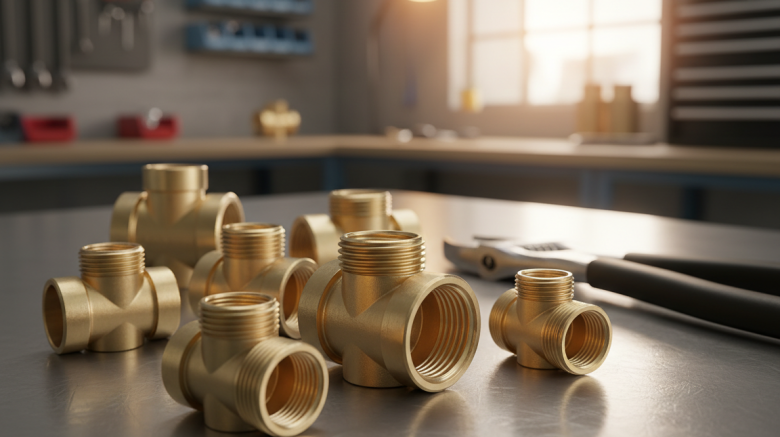
Over seventy percent of maintenance teams favor forged brass fittings for ongoing repair work. They perform longer against leaks than lower-cost options. Brass Forged Compression Tee’s are important components for plumbers, MRO technicians, and engineers. These professionals rely on dependable pipe fittings and brass hardware. These components combine the corrosion resistance of brass with the strength of a forged body. They are well suited for plumbing, hydraulic, pneumatic, and instrumentation systems.
Discover more about 1/2 Compression Tee
Supplier catalogs typically present pricing in a clear format. For instance, SKU FIT-271 is a 5/16″ Brass Compression Tee. It is priced at about $17.69 for one unit and about $8.84 each at three units. This price structure shows how brass hardware and fittings are sold through wholesale distributors such as Installation Parts Supply.
Engineers and buyers benefit from the forged construction when picking components for leak-free assemblies. This guide can help confirm whether the fitting matches copper, aluminum, or thermoplastic tubing. It further helps identify when forged brass tee fittings make the most sense for a given system.
Important Takeaways
- Forged brass compression tees provide excellent durability for plumbing and industrial applications.
- They are distributed through wholesale channels with clearly stated retail and quantity-based pricing.
- Examples like FIT-271 reflect common pricing patterns and SKU structures in the market.
- When fitted properly, these brass fittings are compatible with multiple tubing materials.
- Distributors such as Installation Parts Supply support buyers with inventory access and technical guidance.
Why Choose Forged Brass Tee Fittings For Plumbing And Industrial Use
Forged brass tees strike a perfect balance between strength and longevity in plumbing and industrial settings. Their forging process enhances the metal’s grain structure, reducing the risk of internal flaws and boosting fatigue resistance. This is one reason they are often chosen for jobs that demand reliable connections.
Compression fittings made from forged brass exhibit superior corrosion resistance compared to some alloys and plated materials. Their capacity to handle water, many hydraulic fluids, and typical industrial conditions without rapid degradation is notable. This reliability minimizes maintenance needs and supports long-term installations.
Forged parts generally outperform cast or machined alternatives in terms of strength. They manage higher mechanical loads and offer better crack resistance, even when vibration or handling is involved. As a result, installers and maintenance teams often experience fewer breakdowns and less downtime than they would with weaker cast fittings.
These fittings are built to handle a useful range of temperatures and pressures suitable for plumbing and low- to medium-pressure hydraulic use. Brands like Parker and Eaton offer straight compression fittings with ratings of up to about 500 PSI and operating temperatures from -65°F to +250°F. It’s important to note that these fittings are not suitable for high-vibration steel tubing runs or gaseous media in certain designs, so proper selection is key.
Within plumbing fittings and compressed-fluid systems, forged brass tees stand out because of their durability and resistance to corrosion. They are commonly preferred by plumbers, HVAC technicians, and industrial purchasers. For applications that demand reliable sealing and solid mechanical properties, forged brass tees and matching compression fittings provide a practical and proven solution.
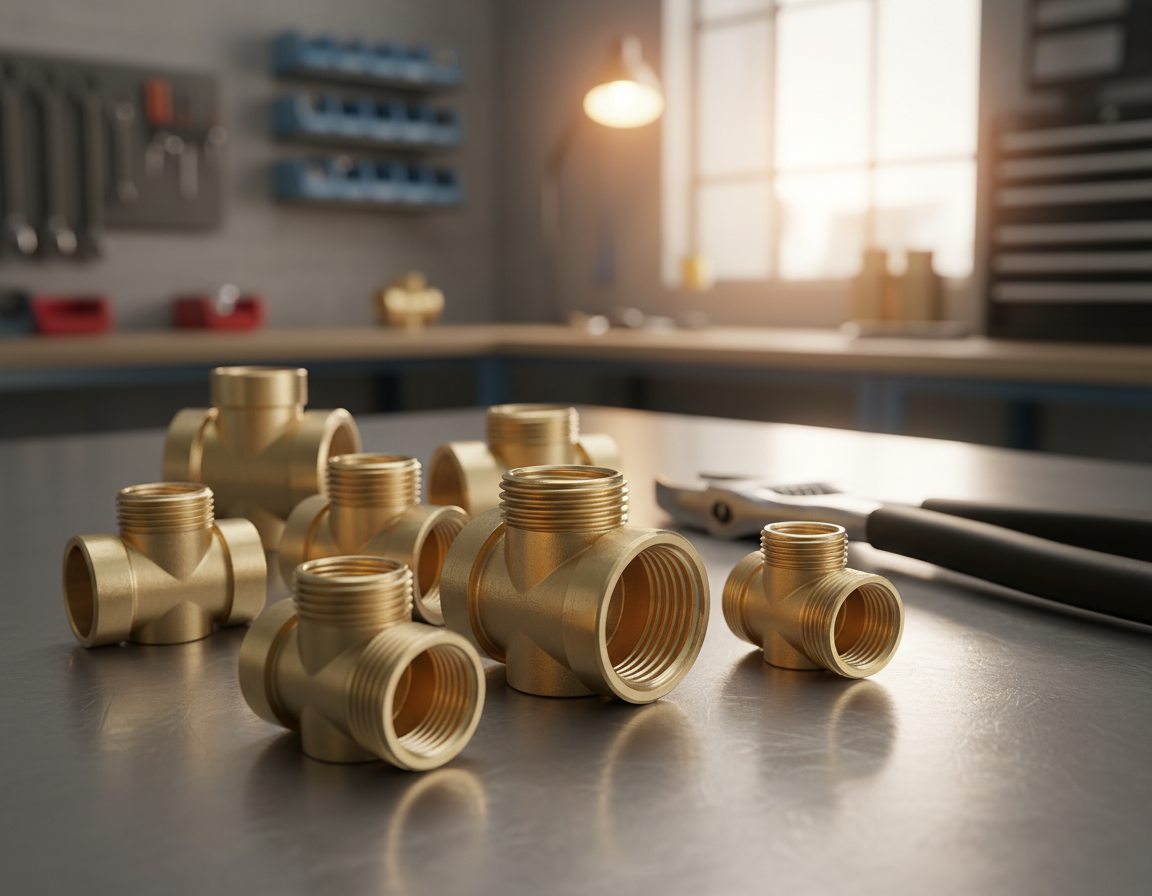
Brass Forged Compression Tee’s
In fluid systems, forged compression tees provide a compact and reliable way to divide or combine flow. These brass fittings are machined to tight tolerances, ensuring a perfect fit with tubing and threaded ports. Catalogs list various types, including branch, run, and union-style tees, alongside elbows and straight fittings for seamless system planning.
Configuration options
Branch tees add a perpendicular branch to a straight run. Run tees keep three pathways aligned to support balanced flow. Union-style tees include a removable section for easier disassembly during maintenance. Each type comes in SAE and NPTF-threaded versions to ensure compatibility with valves and other components.
Compatible tube materials
These compression tee fittings can be used with copper and aluminum tubing without inserts. For thermoplastic tubing, a support insert is necessary to prevent collapse and ensure a tight seal. In certain product lines, manufacturers advise against using these fittings with steel tubing to avoid premature wear in mixed-metal systems.
Where they perform best
Because they resist corrosion and are easy to install, Brass forged compression tee’s are highly suitable for plumbing work. They are likewise common in hydraulic and pneumatic installations such as control manifolds and fluid power lines. Their compact design also makes them useful in HVAC and instrumentation retrofit work.
OEMs, integrators, and MRO teams often choose Brass tee fittings and Compression tee fittings because of their predictable performance and cross-compatibility. Because they are available in both full-pattern and light-pattern versions, they can fit different clearance and thread-engagement needs without forcing a switch to another part family.
Some catalog listings include lead-content notes to support compliance with local plumbing codes. Specification sheets may note whether a part is Not lead free and whether the part number identifies a Light Pattern variation. These details help teams select the correct item for safety, code compliance, and long-term serviceability.
Compression Fitting Features And Working Principles
Compression fittings offer a reliable, solder-free connection through a simple mechanical process. A nut, sleeve (ferrule), and body work together. As the nut tightens, the ferrule compresses around the tube. This compression forms a tight seal between metal surfaces, capable of withstanding typical plumbing and hydraulic pressures without the need for adhesives.
Nut, sleeve, and body interaction
The nut draws the ferrule into the fitting body. When the ferrule bites into the tube, it forms a radial seal and axial grip. This design is ideal for applications where a consistent, leak-resistant joint is essential. Manufacturers like Parker and Eaton test these components to verify that they are compatible with standard Brass fittings and associated Brass hardware.
Hand-tight, tool-free, and grab-ring options
Certain fittings feature grab rings that allow quick hand-tight assembly. This style helps maintenance teams and field installers complete work more quickly. Standard compression tee fittings, on the other hand, require a torque wrench for full compression and optimal performance. Hand-tight designs are suitable where validated for the specific application.
Serviceability and maintenance
Brass compression fittings can often be reused when disassembled properly, although ferrules may deform. Replacing the ferrule and checking the nut before reassembly ensures a leak-free connection in critical systems. Suppliers recommend following manufacturer reuse guidelines to protect the long-term reliability of Brass hardware and Compression tee fittings.
Performance and interchangeability
Components undergo rigorous pressure and temperature testing. This helps installers select compatible parts with greater confidence. Compression fittings generally interchange across SAE-standard brands when size and standard match. This makes it easier to mix parts from trusted names in pipe fittings without compromising performance.
Sizing, Selection Factors, And Common Part Types
Accurate sizing is essential when choosing fittings. Make sure the Tube O.D. matches every compression port. For threaded ports, align the NPTF threads size with the required male or female thread. A minor mismatch can still result in leaks or costly rework.
How to select the proper connection type and size
Use calipers to measure the Tube O.D., then choose the correct compression ferrule and nut. For threaded ports, determine the NPTF thread specification and nominal size, such as 1/8″ or 1/4″ Male NPTF. Supplier catalogs usually provide both dimensions together, such as 1/4″ Tube O.D. x 1/8″ Male NPTF or 5/16″ Tube O.D. x 1/8″ Male NPTF.
Recognizing part variations
Male branch tees are common in many systems and typically feature a compression x compression x male NPTF configuration. They make it possible to combine a tubing run with a threaded branch outlet. Part numbers often contain both size and pattern details. The suffix “L” generally marks a light pattern fitting, meaning a shorter thread length, though it is often interchangeable with a full pattern version.
| Example Part | Configuration | Typical Catalog Size | Notes |
|---|---|---|---|
| BF18291 | Compression x Compression x Male NPTF | 1/4″ Tube O.D. x 1/8″ Male NPTF | Standard male branch tee option |
| BF18292 | Compression x Compression x Male NPTF | 1/4″ Tube O.D. x 1/4″ Male NPTF | Typical configuration for matching branch thread |
| BF18293 | Compression x Compression x Male NPTF | 5/16″ Tube O.D. x 1/8″ Male NPTF | Suitable for larger tube O.D. with 1/8″ branch |
Pressure rating and application fit
Most brass tee fittings are suitable for low- and medium-pressure applications. Some straight compression parts can handle up to 500 PSI and operate between -65°F and +250°F. Before using any fitting in a hydraulic or instrumentation system, always confirm the exact pressure class on the product sheet.
Manufacturers often caution against using some compression designs with gaseous media. Systems with heavy vibration or tube movement may require alternative fittings or additional support to prevent premature failure. Ensure material compatibility, as some fittings may not work with copper, aluminum, or thermoplastic tubing. Thermoplastic lines commonly require an insert.
Sourcing, Pricing, And Wholesale Choices From Installation Parts Supply
Installation Parts Supply offers detailed SKU-level information and quantity-based breaks for quick comparison. They provide catalog examples showing both retail and bulk prices for common Brass hardware items. That makes it easier for buyers to plan budgets and purchasing schedules.
Typical price examples
Pricing for small quantities shows how much single-unit retail differs from discounted wholesale levels. For example, a 5/16″ compression tee, FIT-271, may sell for $17.69 retail and drop to about $8.84 per unit in bulk quantities. Parts like BF18291, BF18292, and BF18293, which are SAE male branch tees, typically range from $7.16 to $7.79. These figures show the savings that can come with bulk purchasing.
Stocking and ordering for distributors and MROs
Distributors and maintenance teams benefit from online visibility of SKUs and inventory counts. Installation Parts Supply provides a Request a Quote process. It collects customer information and shipping details to provide accurate quotes. When bulk orders are involved, extra shipping details help produce firm quotes.
In-stock items facilitate quick fulfillment for repairs and installations. Buyers can place bulk-order requests or RFQs, include project notes, and request certifications. This helps streamline procurement for OEMs and system integrators.
Why buyers choose Installation Parts Supply as a wholesale source
Installation Parts Supply provides a large inventory that supports the needs of MROs, contractors, and integrators. Their product range includes Wholesale brass fittings and Brass Forged Compression Tee’s. Their technical support helps confirm compatibility with different tubing materials and guides buyers on part selection.
They also provide guidance related to SAE standards and pressure connection practices. They supply replacement sleeves and nuts and assist with part selection. This type of support shortens specification cycles and makes bulk purchasing easier.
Lead times, service, and order fulfillment
Established distributors pair transparent Compression fittings pricing with lead-time estimates and responsive customer service. Installation Parts Supply can process quote requests, provide certification information, and coordinate freight for large shipments. Because of their inventory depth, responsiveness, and Brass hardware expertise, procurement can remain reliable across both small and large projects.
Conclusion
Brass Forged Compression Tee’s offer dependable, corrosion-resistant connections for various systems. Their forged construction and ferrule-based sealing help ensure leak-free performance. They are suitable for copper, aluminum, and thermoplastic tubing, though thermoplastic installations require inserts.
When selecting compression fittings, make sure the tube O.D. and thread type are correctly matched. Choose the right pattern based on space, and check the pressure and temperature ratings. Material compatibility is critical; use inserts with thermoplastic lines and confirm that the fittings meet the required pressure class.
When purchasing, distributors like Installation Parts Supply are worth considering. They can offer competitive pricing, bulk discounts, and technical assistance. Request a quote to confirm lead times and volume pricing. Referencing common SKUs can help with comparison, and their support team can assist with secure installation planning.
Related: Kendamil 1: Fortifying with Extra Vitamins for Growth